
Does Biofield Tuning Work? What the Research Says, and What It Doesn’t
Does Biofield Tuning work? Here’s the honest answer: it isn’t proven yet. There is some early research that points in a hopeful direction, a bigger study under way, and plenty of people who say they feel different afterwards. What there isn’t yet is the big, careful, gold-standard evidence that would settle the question either way.
That might not be what you expected from someone who does this for a living. But if you’re the sort of person who has had a school email sitting unopened for three days because the costume deadline feels like one thing too many, and who will still read up on something for an hour before you’ll trust it, I’d rather tell you straight. So here’s what the research says, what it doesn’t, and why a session can still feel like something real.
What the research actually says about Biofield Tuning
There are two studies worth knowing about, and they point in slightly different directions.
The first came out in 2023. Fifteen people who were feeling anxious had three Biofield Tuning sessions over Zoom, one a week. Afterwards, the group reported feeling less anxious, less stressed and less low. That sounds promising, and it is. But it was a small study with no comparison group, so there’s no way to tell how much of the change came from the tuning and how much came from everything around it, like expecting to feel better, or lying down for an hour while someone gives you their full attention. Researchers call this a feasibility study, which is a fancy way of saying “a first test to see if this is worth testing properly.” A bigger, more careful trial is now under way. Until it reports back, this is a hopeful first step and not a proof.
The second study is the one that doesn’t flatter me, so I’m including it on purpose. In 2020, researchers asked three practitioners to move a tuning fork around ten volunteers and mark where they heard the tone change. Then they checked whether the practitioners had picked the same spots. Mostly, they hadn’t. Agreement was around a third. If three people are looking for the same thing and keep finding different things, that’s a fair question mark over the method, and I’d rather you saw it here than found it later.
What do similar approaches tell us?
Biofield Tuning doesn’t have much research of its own yet, so it helps to look at its neighbours. Think of it as checking out the street before you view the house. It can’t tell you about this particular house, but it tells you something.
Let’s start with a sound study. In 2017, Goldsby and colleagues followed 62 adults through a singing bowl meditation. Afterwards, people said they felt less tense, less angry, less tired and less low. There was no comparison group, so it can’t prove the bowls did it. But other research on calming sound and gentle vibration points the same way. It tends to slow the heart and raise something called heart rate variability, which is a measure of how flexibly your body copes with stress.
Then there’s your heart, which makes its own electrical and magnetic signal. HeartMath, a research group that has studied this for decades, works with heart rate variability and has taught people to steady it using breathing and focus. The signal itself is real and measurable. The bigger claim, that the heart’s field stretches several feet out and carries information, is HeartMath’s own idea and is still debated. So it supports the “your body is electrical” idea.
A close cousin in Biofield Therapies is Reiki, and the family it belongs to, which also includes Therapeutic Touch and Healing Touch. Those have been studied far more. A 2008 Cochrane review of 24 studies on Reiki found that people who received these Biofield therapies reported less pain. A 2026 review of 28 trials found effects on pain, and on feelings like anxiety and low mood. Biofield Tuning wasn’t one of the therapies included, so they can’t count as proof that it works. What they show is that across this whole family the results so far are small, and the studies need to get better.
There is also a published study on the effects of Reiki in oncology patients where it was found that REiki may decrease pain, anxiety and fatigue in oncology patients. Promising stuff.
What’s solid, and what’s the method’s own idea
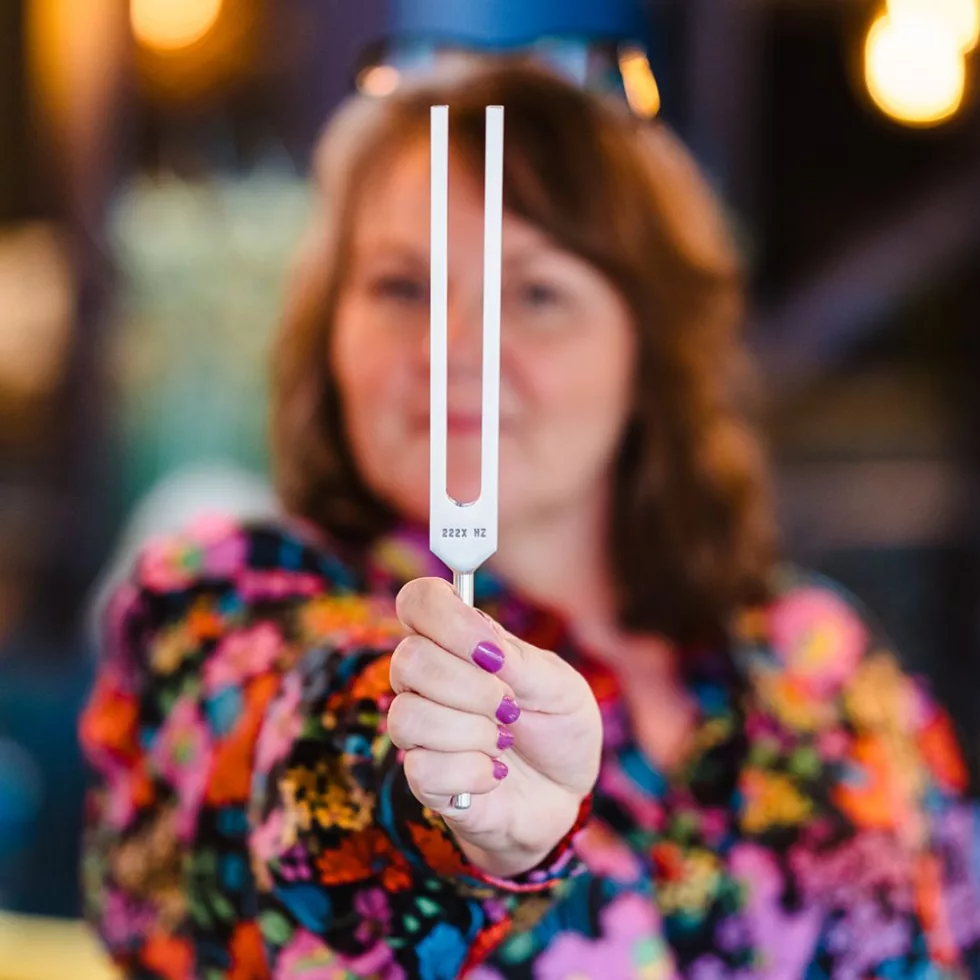
Some of this is plain science. Your body runs on electricity. Your heart and brain give off tiny electrical and magnetic signals, which is exactly what the machines at the hospital measure. Sound is physical too: a tuning fork has a real, measurable pitch, and your body responds to vibration. None of that is up for debate.
Biofield Tuning goes one step further and says that stress and old experiences leave a kind of mark in the field around your body, and that a tuning fork can find that mark by listening for where the tone changes. That’s the method’s own idea. Physics hasn’t confirmed it. Plenty of people find it useful, practitioners feel it, as do clients reeving Biofield Tuning – but it’s still an idea. (If you’re wondering where the word “biofield” came from, it’s a surprisingly official story involving a 1992 conference at the US National Institutes of Health, and I’ve told it in What Is Biofield Tuning?.)
What does a Biofield Tuning session feel like?
Let’s be fair to the sceptics first. If you lie down for an hour, somebody gives you their full attention, and you expect to feel calmer, you will probably feel calmer. That’s true of loads of things, from a massage to a really good nap. But that doesn’t make the feeling fake. It does make it hard to know what’s doing what.
Here’s what I can offer instead: what I’ve actually seen. A client once told me, “There is a softness and ease that wasn’t there before.” Another said, “My sleep has improved massively.” Those aren’t measurements, and I’m not offering them as proof. They’re what people tell me days and weeks afterwards. Sleeping better. Snapping less. Noticing that the thing that used to wreck their morning barely makes a ripple. That’s the part I find hard to put down to a nice lie-down alone… You can read more of my client testimonials about Biofield Tuning here and my Google reviews tell a similar story about Biofield Tuning.
Picture a tree. The leaves are your thoughts: the story, the insight, the bit you can explain at a dinner party. The tree itself is your body, which holds the reaction, like tight shoulders or the mid-afternoon crash. The soil is underneath all of it, before any of it turns into words. Most approaches start with the leaves, and talking things through really does help. Biofield Tuning is built on the idea of starting in the soil. Whether that idea is right is exactly what the research is still working out. What I can tell you is that the people who book with me are usually the ones who understand their patterns perfectly well and are still waiting for their body to catch up.
What the fork is actually doing in the room, and why the ones I use are different from the ones you’ve seen in reels, is in Tuning Forks for Healing.
What To Expect In A Biofield Tuning Session
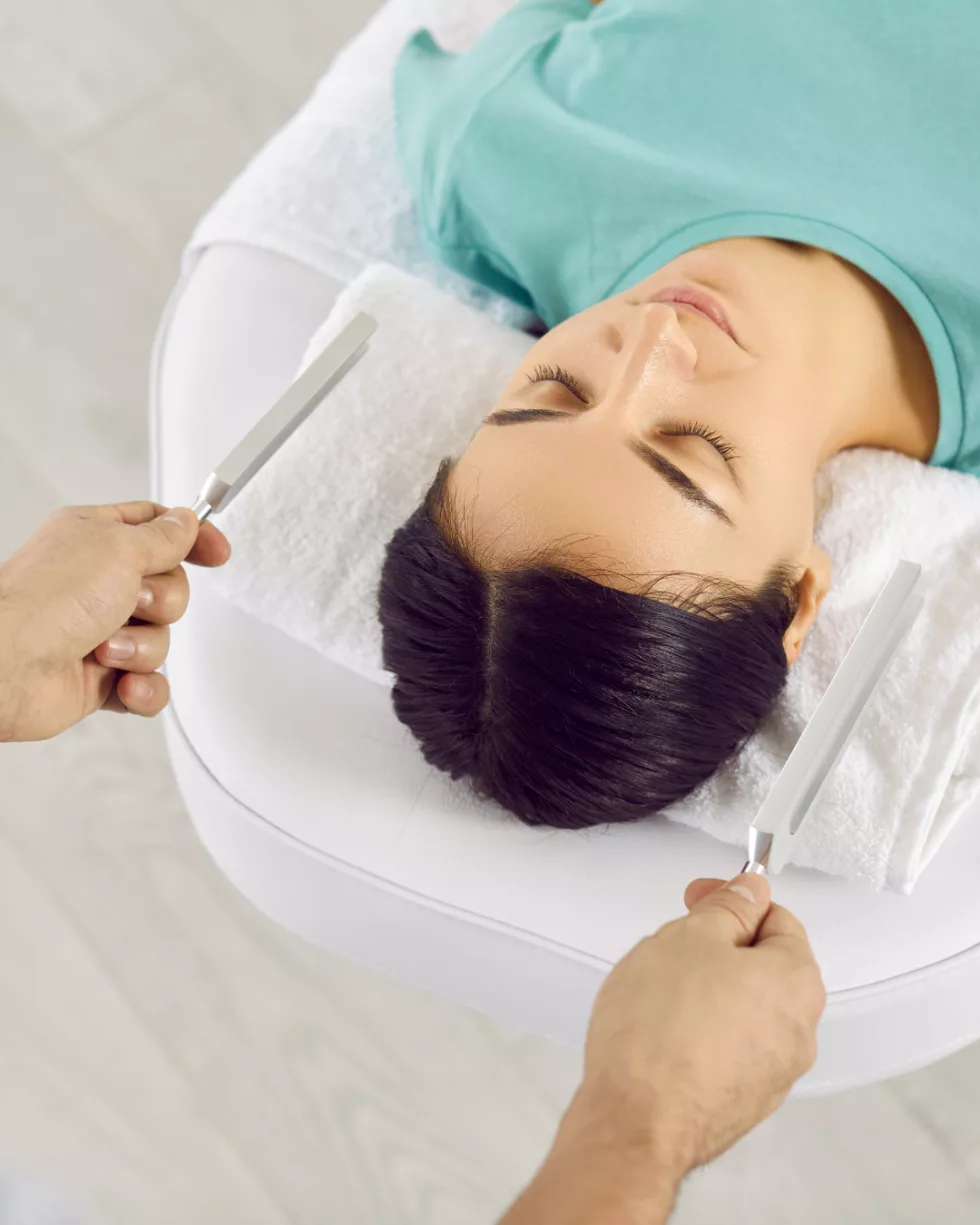
You stay fully clothed and lie down. I move a tuning fork slowly through the space around you and listen for where the tone changes. You don’t have to explain your history or find the right words. A session takes around an hour, in person in Peterborough or online, and clients tell me the online ones feel just as strong. (The 2023 study was run entirely online, too.) For the full detail, the main Biofield Tuning page covers it in depth.
So, does Biofield Tuning work? The early research is hopeful, a bigger trial is on its way, and the idea that a tuning fork can find stress in the field around your body is an interesting one. What I can tell you is what I’ve seen: people lying down for an hour and getting up lighter, sleeping better, having reduced anxiety, pain and finding that the things that used to overwhelm them barely affect them. If you’d like to find out what it feels like from the inside, a free Clarity Call is the easy way in. It’s twenty minutes, no pressure, and your most sceptical questions are very welcome.
You don’t have to believe any of this to find out what it feels like.
Kellie Rose holds a BA (Hons) in Psychology and is a fully insured Certified Biofield Tuning Practitioner (trained in Eileen McKusick's method), Certified Havening Techniques Practitioner, and PSYCH-K® Master Facilitator, based in Peterborough, UK, offering sessions in person in Cambridgeshire and worldwide online.
Questions people ask about Biofield Tuning
Does Biofield Tuning work?
Research is early, but promising. One small early study found people felt less anxious afterwards, but it had no comparison group, and a bigger trial is under way. In my experience, clients often notice better sleep, less reactivity and more ease in the days after a session.
What does the research say about Biofield Tuning?
There’s a small 2023 study that found less anxiety, less stress and fewer low feelings afterwards. There’s a 2020 study in which practitioners mostly couldn’t agree on where the tone changed. And there’s a larger trial currently under way.
Is Biofield Tuning just the placebo effect?
Possibly, and nobody has pulled the two apart yet. The 2023 study had no comparison group, so it can’t tell the difference between the method and everything around the method, like attention, rest and expectation. What I can tell you is what clients report afterwards.
Is Biofield Tuning safe?
Yes. It’s non-invasive. You stay fully clothed and nothing goes into or onto your body. Most people feel calm and lighter afterwards, though occasionally some may feel tired, a bit emotional or headachy for a day. In the 2023 study, five of the 15 people reported short-lived symptoms like headache, aches or disturbed sleep. It isn’t a replacement for medical care, so if you’re struggling with your health, please keep your doctor in the loop.
How many sessions before I notice a difference?
Every person is different. Some people notice something after one session. In my experience most find that three to five sessions make a bigger difference to how they feel day to day, and we’d talk about what makes sense for you on a Clarity Call.