
Tuning Forks for Healing
Tuning forks are used for healing by sounding a precisely-pitched fork near or on the body and letting the vibration interact with tension held in the body’s tissue and the field around it.
In Biofield Tuning specifically, the fork does something more than that. It’s used diagnostically – I move it through the space around your body and listen for where the tone changes. That change is information: a sign of tension the body’s been holding. The fork stays there, putting out a steady tone, while that tension settles as it matches the orderly tone of the tuning fork.
You’ve probably seen a tuning fork before. Pressed to a collarbone in an Instagram reel. Laid on someone’s back in a spa treatment. From the outside, it looks the same as what happens in my Biofield Tuning sessions.
It isn’t.
If you’re the one everyone leans on – holding it all together, still awake at 3am while your mind replays the same loop – here’s why that difference matters.
The Field Is The Soil
Most approaches to stress start at the top, in your mind. You’re asked to think about what happened, make sense of it, find the insight. And it helps. Up to a point.
For a lot of women, that point arrives and nothing moves past it. You understand exactly what’s going on. You can explain it to anyone who asks. And you still snapped at your kids before 9am and spent the rest of the day silently apologising for it inside your own head.
Think of it like this:
The field is the soil. It holds what’s happened to you before any of it becomes a thought.
The body is the tree. It holds the reaction. The clenched jaw. The racing pulse.
The mind is the leaves. The story. The insight. The part you can already talk about fluently.
A tuning fork in your field doesn’t start at the leaves. It starts in the soil. And it does it before language gets involved at all. And the soil affects everything upstream.
What The Tuning Fork Is Actually Doing
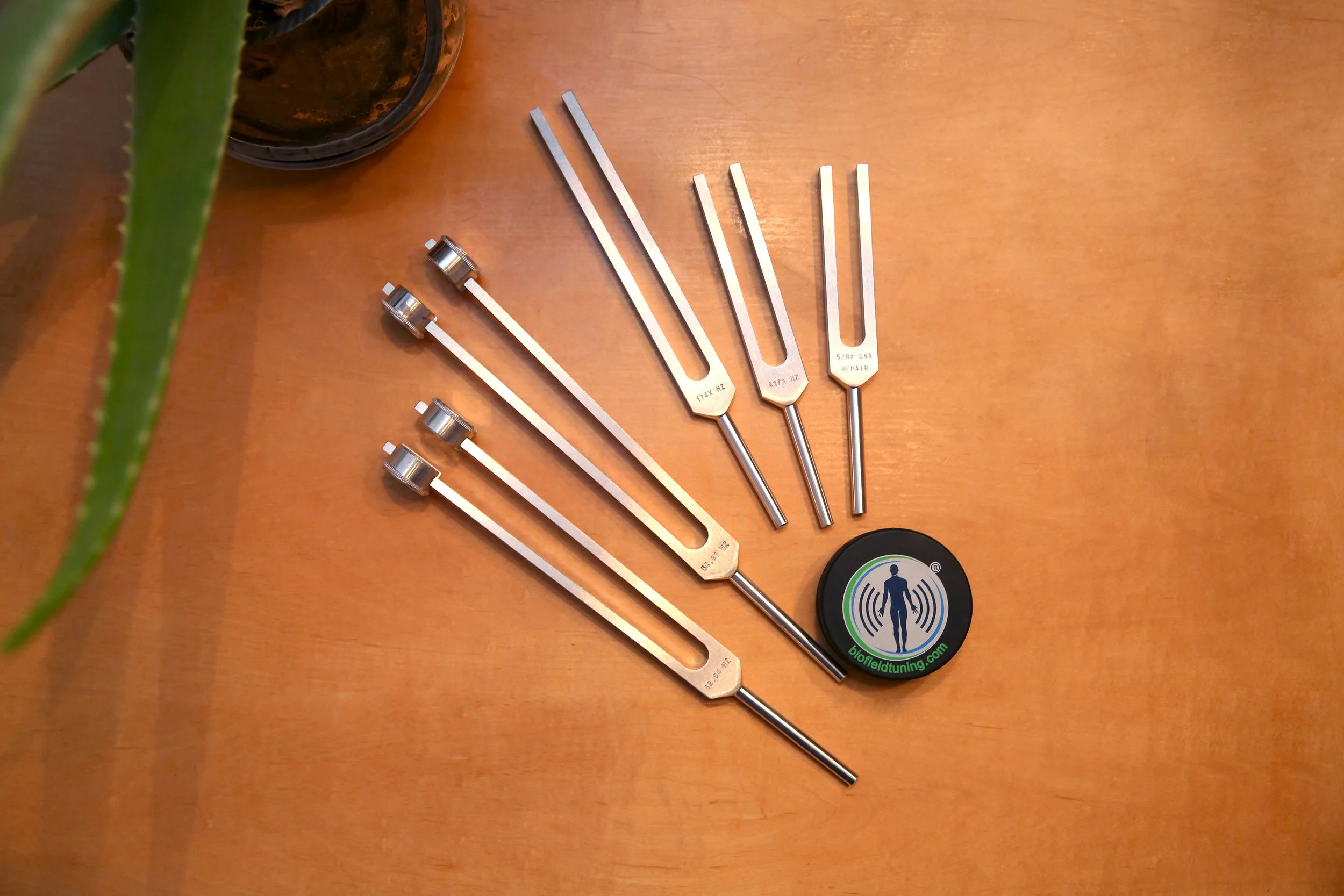
Unlike a chiropractic reflex fork or the ones used for tuning pianos, the tuning forks used in Biofield Tuning can be both weighter and unweighted. They ring long and pure, and that steady, coherent tone is the whole point.
I move a tuning fork slowly through the space around your body, listening. Where the field is holding something, old tension, a pattern that’s been running in the background, the tone catches. It might sound duller. Or slightly wonky. Or screechy. Or any other number of things. Where the field static has cleared, the tone rings bright and open.
When I find a place where the tone has changed, I stay there. I’m not pushing or manipulating anything. The fork keeps sounding, steady and unwavering, and the tension that’s been held against something finally has a reference point to settle against.
Often the tone itself changes as this happens. It clarifies. The wonky edge softens into something bright, clear and open.
You don’t have to understand any of this while it’s happening. Most people don’t. One client described it simply: “the tuning forks themselves were incredibly relaxing.”
That’s usually where it starts. Not with the consious mind. With your body doing something thinking can’t reach on its own.
Different Tuning Forks, Different Character
In many tuning fork modalities frequency is matched to a frequency… eg the kidneys have a frequency of (I’m making this up on purpose) 440-ish hertz… so a practitioner dings this frequency fork and the kidneys come into coherence. In Biofield Tuning we have a different approach.
In my experience, each fork brings something different.
The 144Hz fork lands like a sledgehammer. Blunt and direct. The one I reach for when something feels dense and really stuck.
The 417Hz fork works differently. It sings to loosen old patterns, and there’s a playfulness to how it does it rather than force.
Sound the 417Hz and 528Hz forks together and you get something else again. The two tones interfere with each other and produce an audible beat, a soft pulse sitting around 111Hz. The quality of that pulse is unmistakable: soft, playful, angelic.
The 174Hz fork is often considered the workhorse of Biofield Tuning. It has the most expansive audible range of any fork I use – rich in high, mid and low tones all at once – which makes it unusually diagnostic to listen to. It’s also the fork used in the one published inter-rater study on the technique, which gives it a slightly different kind of credibility to the others.
The Schumann pair – two weighted forks tuned close to the Earth’s Schumann resonance – are the ones I reach for when I want to calm and soothe someone. Sounded together, the two tones produce a gentle acoustic beat, and in my experience it’s one of the most pleasing and relaxing combinations I use.
The Fibonacci pair is tuned to the golden ratio – a mathematical relationship found throughout nature. This is the pair I reach for when I want to bring someone back to what feels like their own blueprint. They are a reset pair of forks.
None of this is measured or verified beyond what I’ve noticed across hundreds of sessions. It’s practitioner experience, not a claim about what any particular frequency does to you. But it’s part of why the choice of fork matters as much as the technique itself.
What’s Measurable, And What Isn’t
Sound is physical. A tuning fork has a real, measurable frequency, and your body’s response to vibration and steady sound is understood at a cellular level. That much sits comfortably within mainstream science.
What Biofield Tuning adds on top of that, that a fork’s tone can locate and work with tension held in a field around the body, is the method’s own framework, not something independently confirmed by physics. I’d rather tell you that plainly than dress it up. (If you want the fuller picture of where that framework comes from – including the term “biofield” itself – I’ve gone into it in What Is Biofield Tuning?)
Where there is early formal evidence: a 2023 feasibility study of Biofield Tuning found real reductions in anxiety across participants, and a larger randomised trial is currently under way. It’s a feasibility study, not a completed randomised trial. I’ve set out what that study found, and a second one that didn’t flatter the method, in Does Biofield Tuning Work?
What I can tell you honestly is what I’ve watched happen, session after session: women who’ve done years of talk therapy, who understand their patterns completely, feeling something settle in a single hour that talking never did.

What To Expect In A Biofield Tuning Session
You stay fully clothed, lying down, while I work with the forks in the space around you. There’s no need to narrate what’s going on for you or explain your history.
Sessions typically run around sixty minutes, whether in person or remote. Distance doesn’t change how the forks work, which surprises most people the first time they try a session online.
For the full detail on what a session involves and the fuller evidence picture, the main Biofield Tuning page covers that in more depth.
You don’t need to understand how a tuning fork works to notice what happens when one finds the right place. Most people don’t, until it does. If you’re curious what that feels like for you, a Clarity Call is the easiest way to find out – twenty minutes, no obligation, just a chat about where you’re at.
Kellie Rose holds a BA (Hons) in Psychology and is a fully insured Certified Biofield Tuning Practitioner (trained in Eileen McKusick's method), Certified Havening Techniques Practitioner, and PSYCH-K® Master Facilitator, based in Peterborough, UK, offering sessions in person in Cambridgeshire and worldwide online.
Frequently Asked Questions
What are tuning forks used for in healing?
They’re sounded near or on the body so the vibration and steady tone can interact with tension held in the tissue and, in Biofield Tuning specifically, the field around it.
Are all healing tuning forks the same?
No. Weighted forks (used in some massage and chiropractic settings) are struck and pressed onto bone for vibration alone. The unweighted forks used in Biofield Tuning are sounded in the air around the body and used diagnostically, listening for where the tone changes, not just applying vibration.
Do the tuning forks touch my body?
They can, but most of the work happens with the fork sounding in the space around you rather than resting on your body.
What does it feel like when a fork finds something?
People describe warmth, tingling, yawning, or a sense of something loosening. Some feel very little in the moment and notice the change afterwards instead. Both are normal.
Is there research on tuning forks for healing?
Early research is encouraging but limited, and a larger trial is currently under way. It isn’t yet backed by large randomised studies.